Patricia Muñoz: “what is financed with public resources must be available for the generation of new knowledge”
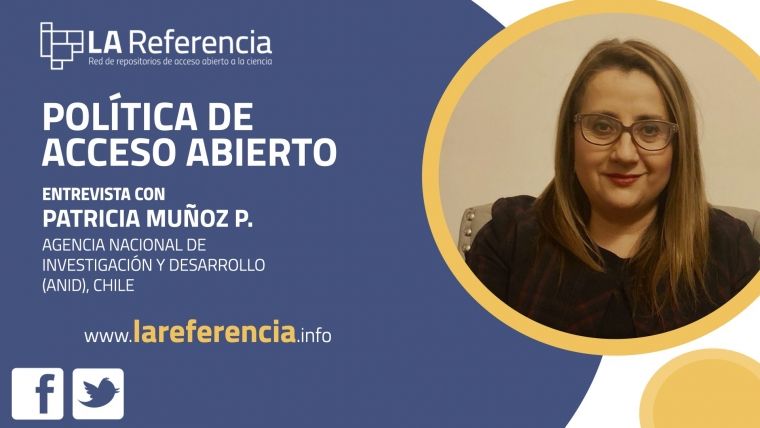
- Interview on the Open Access Policy proposed by the National Research and Development Agency (ANID), Chile.
LA Referencia spoke with Patricia Muñoz, in charge of the Scientific Information Program of the [National Research and Development Agency (ANID)] (https://www.anid.cl/), of Chile, to learn about the work that this entity is doing so that the country implements, starting in 2020, the Open Access Policy to Scientific Information and Research Data.
Muñoz pointed out that work has been underway on the Open Access Policy for more than 10 years, specifically from the moment Chile made its entry process into the Organization for Economic Cooperation and Development (OECD). This organization pointed out to the country the need to improve accessibility to scientific data, especially those generated from financing with public funds.
The basis for generating the initiative was developed from the former National Commission for Scientific and Technological Research (CONICYT), an institution that ended up becoming ANID.
During the process that allowed us to create the Policy, the work team approached the different scientific communities and interested publics in order to understand the existing culture regarding data.
Muñoz commented in the interview that the Policy was stopped for a while, but this allowed the world to advance on the issue of science and open data, which made it possible to find better solutions to challenges that had been identified some time ago: use of platforms, data management, among others. He even specified that LA Referencia has played an important role in the context of technological infrastructure, which is why he considers that the organization “has a great presence in generating technical and service competencies that not all countries have.”
This Policy also has as a background an almost personal vision - paraphrasing Muñoz Palma - and in which this initiative is summarized: “what is financed with public resources must be available for the generation of new knowledge, to generate competencies, to accelerate research processes. In this sense the Policy responds to that.”
According to the [written document of the Policy] (https://s3.amazonaws.com/documentos.anid.cl/estudios/Politica_acceso_a_informacion_cientifica_version_final_26-05-2020.pdf), it is defined in two phases:
· First Phase: follows the [Green Route] model (https://universoabierto.org/2019/03/13/las-5-rutas-para-llegar-al-acceso-abierto-verde-dorada-bronce-hibrida-y-diamante/). The data responds to the FAIR principles (in English: Findability, Accessibility, Interoperability and Resusability), that is: Findable, Accessible, Interoperable and Reusable. The aim is to compile, within a period of two years, the necessary background information on the use of information and data, the costs associated with its management and the expenses incurred by researchers when publishing.
· Second phase: at this time we will seek to implement theGolden Route, where the embargo periods of the Green Route would be eliminated and the publications would be made available in open access immediately.
Finally, Muñoz is clear that this initiative poses challenges, and he explained that “this is a change that is in keeping with the times, yes, but it is a cultural change for many.”
Here you can find the summary of the interview that was carried out