
Bianca Amaro, president of LA Reference: “We are achieving visibility as a region that we did not have before”
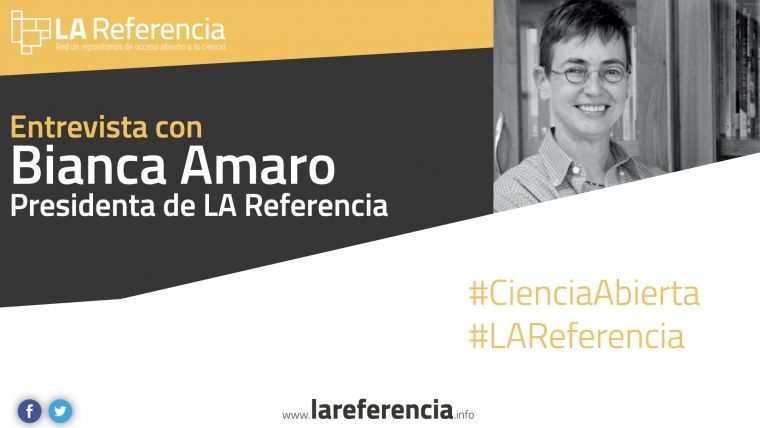
For Bianca Amaro, president of LA Reference, the work carried out during her administration is summarized in different attempts for other countries in the region to enter the Network. This work focuses on discussions aimed at raising awareness of the importance of open science for countries, as well as the benefits that being part of LA Reference offers. This has led Amaro to emphasize that “we are achieving visibility as a region that we did not have before.”
These efforts to add more countries to LA Reference, comments Amaro, are not a conviction,** but rather teaching that a block action is much more effective than an action by a single country or even micro-regions within the same Latin American region.** For Amaro, being part of this Network brings many benefits.
Precisely, one of the greatest benefits is the technological advances that have been achieved over the years. LA Reference provides its member countries with support in this regard, seeking to create technological facilities for access to Open Science.
Amaro explains that “many technological advances have been launched and they are widely recognized around the world. All initiatives want to listen to the position of LA Reference,” he pointed out.**
For the president of LA Reference, the biggest challenge continues to be precisely the expansion of the Network. Amaro considers that the people in charge of science affairs in the countries have forgotten that science is a public good. “But when we talk about science, people have a preconceived mentality and say, public but not that public, so it is difficult to try to make them understand that precisely what is done with public resources must be public,” Amaro explained.
Fighting the myths around open science and everything it means has also been another of the walls that Amaro has tried to break down. “One of the most serious is that they are going to steal my research, or they are going to steal our national science and this is a myth, it is false, there is a saying that says: as open as possible and as closed when necessary,” Amaro highlighted.
Regarding this challenge, Amaro affirms that through efforts like LA Reference, the world “… will know our science, and they will value it.”
Finally, Amaro considers that the future work of LA Reference should be focused on structuring what has already been achieved, that is, on promoting practices related to Open Science, as well as promoting the creation of legislation on Open Access, because, he considers, “this makes it less difficult for countries to act.”